Kilt Outfits

Traditional Scottish kilt outfits for special occasions, designed to last for generations. Create a kilt outfit that fits your personality, made with the highest level of care and detail.

Celebrate your Scottish heritage with a kilt in your clan tartan or simply choose your favourite. Our in-stock kilt range is available in a variety of general Scottish tartans and select clan tartans, don't forget your kilt accessories!  

You may also like
Kilts Kilt Jackets Tartan & Tweed Suits Tartan Jackets

The Components of a Traditional Scottish Kilt Outfit

Gentleman standing in a a traditional full kilt outfit with text labels for each piece of clothing and accessories

The Finishing Touches: Kilt Outfit Accessories

close up image of a mannequin wearing a white shirt, black waistcoat and blue tartan bow tie

Bow Ties & Ties

A Prince Charlie outfit & wing collar shirt must be worn with a bow tie, whereas any kind of tie be it plain or tartan, can be worn with an Argyll outfit.

gentleman sitting down wearing a tartan waistcoat with close up of his left arm with right hand holding on to cuff of white shirt fixing tartan cufflink

Cufflinks

Finish off those cuffs with cufflinks in tartan to match your kilt, opt to show off your clan crest in pewter or continue the traditional thistle theme. 

Close up image of a gentleman walking down steps wearing a full kilt outfit with large grey fur dress sporran

Sporran

An essential part of any kilt outfit! Many sporran styles are available, usually made from animal hide, and are an opportunity to make quite a statement.

Close up of a Celtic design antique style kilt pin on a brown, blue, red and yellow tweed kilt

Kilt Pins

Your kilt pin should be pinned on the apron of the kilt & acts as a weight on windy days. Choose a traditional Scottish style or wear your clan crest. 

Close up of man on steps in kilt shoes, ecru kilt socks and douglas ancient kilt and kilt flashes

Kilt Socks

Kilt socks are another opportunity to add a little colour and highlight a stripe in your tartan, or go muted and match with the base colour or stick to simple and traditional Ecru.

Close up of kilt flashes in MacPherson Hunting Ancient tartan

Kilt Flashes

Go for tartan to match your kilt or pick out a stripe with a plain colour. Your kilt flashes have a practical purpose and hold your socks up to cope with even the wildest ceilidh.

Close up of Lochy Sgian Dubh in top of kilt sock

Sgian Dubh

Tucked in to the top of your kilt hose ready to fend off Highland raiders, we have real and safety Sgian Dubhs as well as the very handy Sgian Brew bottle opening variety.

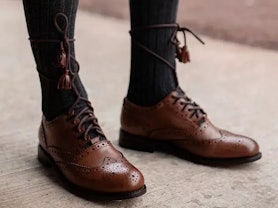
Close up of black kilt socks and tan Ghillie Brogues

Ghillie Brogues

Black, tan or tartan, don't panic we have a guide to help you tie those long laces. Quality leather guarantees you comfort and a shoe that will last for years.

A male & female couple stood together in front of trees. Blonde haired female wearing a red tartan kilted skirt, white blouse & a faux fur and tartan stole with matching shoes and bag. Fair haired male wearing a red tartan kilt, matching tartan tie with grey tweed jacket & waistcoat, white kilt socks and black kilt brogues.
A dark haired man stood leaning against a stone wall wearing a formal kilt outfit including prince Charlie jacket & waistcoat with a red & green tartan kilt, bow tie, fly plaid & brooch.
A tall dark haired man, stepping down stone steps with one hand on a metal hand rail wearing a brown mix tartan kilt with a grey tweed jacket & waistcoat, large dress sporran, tartan tie and white kilt socks.

Kilts & Kilt Outfit Frequently Asked Questions (FAQ)

Here are your most frequently asked questions on our kilts and kilt outfits. If you can't find the answer to your question and it is about a specific product you might find it on the product page. If not then please use LiveChat, e-mail us or give us a call and we will answer your questions as quickly as we can.

Why do the Scots wear kilts?

    Kilts are the national dress of Scotland, a time honoured symbol of identity and patriotism, as well as being a way for men to show their clan allegiance. Originating in the Scottish Highlands, the early Scottish kilts were multi-purpose; they provided excellent protection from the weather and elements, they served to cover and guard weapons such as muskets worn about the person, they could be removed and used as a camping blanket, and they served as a marker of wealth and status depending on their size and material.

Can you wear a kilt if you're not Scottish?

    Anyone can wear a kilt if they choose to, there are no set rules. There is however, a set way for a kilt to be worn:

    • The pleats go at the back
    • The kilt waistband should sit at the naval
    • The length should hang to about mid-way over the kneecap
    • Belts should only be worn when not wearing a sporran
    • The kilt pin should only be attached to the top layer of the kilt
Which tartan should I choose for my kilt?

    Traditionally you should wear your 'clan' or family tartan, if you're not sure which clan you belong to you can use our search to find out. There are many variations of clan tartans. If you don't have any clan connections, or perhaps you're not of direct Scottish decent you can choose from many generic or district tartans.

What is traditionally worn with a kilt?

    The key components of a kilt outfit are as follows:

    • Kilt Jacket & Waistcoat - Argyll or Prince Charlie
    • Shirt- Winged or Standard collar
    • Tie or Bow Tie
    • Cufflinks
    • Sporran
    • Kilt Pin
    • Socks/Hose
    • Kilt Flashes
    • Sgian Dubh
    • Ghillie Brogues
Which kilt jacket should I wear?

    There are two kilt jacket options, the Prince Charlie or the Argyll. Considered the more formal of the two, the Prince Charlie jacket and waistcoat is seen as the more formal of the two, commonly worn as evening wear to weddings and black tie events. This is only available in black and should be paired with a wing collar shirt and bow tie. The Argyll jacket is available in black as well as several other tweed colourways and is a more casual style suitable for all day weddings and day-time events. This jacket is worn with a standard collared shirt and standard tie.

Should the pleats on a kilt be worn to the front or back?

    The traditional and correct way to wear a kilt is with the pleats to the back and fringing on the right hand side. As well as tradition, there is also the practical element of this where the pleats being worn to the rear is for comfort and ease of movement. 

Can’t find the answer you’re looking for?

Send us your question

Kilt Measuring Experience

Create your very own kilt outfit with our exclusive ScotlandShop Kilt Measuring Experience, available at our Edinburgh, Crieff and Albany, NY stores. Our expert team will take your measurements and guide you through from the main outfit elements, to all of the accompanying accessories and every little bespoke detail, all while explaining the history and traditions of this national dress.

Close up image showing a man wearing a tweed tartan kilt. black socks and a traditional kilt pin

How to look after your kilt

Buying a kilt is a rite of passage for many Scots and those of Scottish descent across the world. It is not only an investment in your heritage, but an investment in a high-quality garment. A good kilt can become a family heirloom, lasting for at least a generation or two if cared for properly. Whether you already own a kilt or are thinking about buying one, we're here to help with an informative guide on how to care for your kilt.

The Great Kilt

Do you want to be truly traditional when you don a kilt? If so, then you want to go for The Great Kilt, also known as the feileadh mòr, which was a piece of cloth 8 yards long that was pleated and wrapped around the body to create what we know as a kilt. Today we teach you how to pleat and wear a Great Kilt. Check out our selection of 16oz Tartan Fabric so you can create your very own version.